The Reveal

March 31, 2008

Mas and I found this stone on our first date, a collecting trip to Black Butte Reservoir in Northern California. It was Thanksgiving weekend in 2004 and the weather was ice cold and with a strong north wind blowing. The stone has several significant features, including the amazing autumn colors, the large tamari or waterpool, and the steep cliff recessed under a big overhang. By contrast, the surface features, including the two small peaks to either side of the tamari, are more restrained and gentle.

Soon after bringing it home, Mas made a daiza. Sometimes when so many interesting features are present the viewer’s eye gets lost. Simplicity is one of the most important aesthetic virtues for a suiseki. Mas wanted to simplify the stone by emphasizing the tamari and surface features. This gives the suiseki a modest, settled feeling. We kept the suiseki in the living room and enjoyed our memories of that day.

Recently, Mas took the stone out of the daiza and put it on the table. He didn’t have any intention of redoing it, but while looking at the stone he started appreciating the cliff area. He thought it enhanced the stone rather than detracting so he decided to open up the front of the daiza to reveal this unique feature.

It seems to me that he has revealed the heart of the stone. Its features combine in a dynamic harmony, and the recessed cliff gives a sense of depth and mystery. Removing the wall of wood from the front also allows the eye to appreciate the subtle movements of the stone surface, and perhaps creates more room for the viewer’s imagination.

Untitled; W 10″ x H 4″ x D 7 1/2″; Jasper and Black Walnut

< Previous | Home | Next >


To Cut or Not to Cut

March 9, 2008

The central feature of a suiseki art piece is a found object – a stone – that has been shaped entirely by Nature. So it’s understandable that, whenever suiseki lovers get together, the conversation almost always gets around to the issue of whether or not it is okay to cut a stone when making a suiseki.

There are different teachings and practices both here in the U.S. and in Japan (and much argument in both places). In my view it’s really an artistic decision rather than a matter of “okay” or “not okay”.

Some people come at the cutting issue from a conceptual point of view – they often express the feeling that cutting a stone damages the spirit of the stone. (Many people use the Japanese term kami, but the ancient Greek concept of a nymph probably serves just as well.) This is certainly in keeping with the historical roots of suiseki as objects which brought Nature indoors for Zen meditation and the Tea Ceremony. Suiban display is commonly used to express this feeling.

Other people are more concerned with the suiseki as a visual object. In this view, the artistic composition – the line, form, and visual balance – is the primary concern. For this group, it is acceptable to cut a stone if it improves the artistic composition – provided that it results in a good suiseki. Suiseki is treated more as Art in our modern sense, rather than seeing it through the lens of traditional spiritual belief. (See my earlier post on that topic.)

Neither point of view is “right” or “wrong”, and they aren’t even mutually exclusive. Some people emphasize the conceptual – and may be more forgiving of compositional “flaws” in uncut stones. The other group emphasizes the composition and is more forgiving of the human intrusion of cutting.

Here in Northern California, most people seem to follow the same practice as the Nippon Suiseki Association (see their FAQ here). We consider stone cutting to be acceptable – though good un-cut stones are more valued. There is however one significant difference between our practice and the Japanese practice.

For aesthetic reasons, the Japanese artists use various techniques (such as sandblasting) to modify the bottom face and edges of a cut stone so as to conceal the smooth face. In some cases additional work may even be done on the visible parts of the stone to modify the shape. This work is usually done very skillfully and is difficult to detect. (In the commercial world of course the seller should disclose this to you. I have a couple of Japanese suiseki, and I only found out later that they had been modified. However, they are beautiful stones and I enjoy them both.)

By contrast, our Northern California practice is to grind the sharp edges in order to make a good transition into the daiza, and no attempt is made to conceal the cut face itself. I am not aware of any Northern California artists (or commercial dealers) that make a practice of modifying the visible shape and people consider it to be improper and not part of the suiseki aesthetic.

Mas feels that the decision depends on the individual stone and what it needs. He will cut a stone, but only when the resulting suiseki will be very good.

Late Fall (shown in the photo below) is an fine example of a cut-stone suiseki. It is a classic mountain-shaped stone (山形 yamagata) that meets all the requirements of the rule of three-sides (三面の法 sanmen-no-hou). It has good asymmetrical balance, a well-defined straight peak, and the peak and both ends all come slightly forward towards the viewer (what is called good kamae 構). The stone material is good well-weathered serpentine, with a subdued deep brown color and interesting textures that enhance the lines of the stone, and is starting to show age and patina. This suiseki is currently in our entry way, and I enjoy seeing it every time I walk through.

“Late Fall”; W 16″ x D 7″ x H 6″; Clear Creek serpentine

< Previous | Home | Next >


Something old, something new

January 23, 2008

We held the Bay Island Bonsai 9th annual exhibit this past weekend, and for the third year in a row Mas was a guest exhibitor. Boon gives him free rein to do whatever he wants, so last year he made an entirely contemporary display with his Suiseki Art piece “Akebono”. This year Mas chose to combine a very traditional suiban display with one of his recent paintings. After creating the display, he titled it “Silence” (静寂 seijaku).

When we were creating this display Mas first tried a more traditional approach, using a calligraphy scroll that his mother had given us. The scroll has the character 然 (zen) which comes from the word shizen, or “nature”. It didn’t look good – the calligraphy was very strong and overpowered the stone, stealing all the attention. On top of that, the meaning of calligraphy is an essential part of it – you aren’t using it just for its visual appearance. Something essential is lost if the great majority of viewers don’t know the meaning.

So we started looking at some of Mas’ recent paintings from last summer. This painting was not made with any intention of displaying it with a suiseki, but when we tried it with this stone and suiban we realized how well they complemented each other.

Mas deliberately avoided giving a descriptive name or label to either the stone or painting . Having a description such as “coastal rock” or “waterpool” limits the viewer’s own imagination. For me, this display is a memory of morning on the Klamath river, surrounded by forest, with the mist rising off the water. For a fellow BIB member (of more practical bent perhaps) the painting seemed like a micrograph of the stone itself.

Having a suiseki display among bonsai gives a moment’s rest while going though the exhibit. In the midst of the trees is a quiet clearing where you can gather your thoughts and go on refreshed.

< Previous | Home | Next >


The Art of Craft

December 27, 2007


Mas and I recently visited his family home in Dachi, a small town in Gifu prefecture. Mas’ older brother, Zenji Nakashima, runs the family business, a small sake brewery named Chigonoiwa. The new rice from the harvest was available and they were just beginning the year’s sake making.

20071018-IMG_0018 3264 x 2448

The basic idea for making sake is simple. You take highly polished rice and cook it; mix in enzymes (in the form of a mold called kōji) that break the starch down to sugar, add water, yeast, and time and you end up with sake. But of course, this simplicity masks the complexity which is the sake brewer’s art.

When Mas was a child the toji (brew master) would come every fall from Niigata with a team of workers to make the sake. They were farmers who had no work at home once the snows came. They left their wives and families behind, and lived all winter at the brewery with the Nakashima family. Now of course this system is pretty much gone. The farmers have other means of year-round employment nearer to their homes and no longer need to spend months apart from their families.

The economics of the sake business have also changed since those post-war days. A few large breweries dominate the business, using efficient mass-production techniques to make good, inexpensive sake and distribute it around Japan (and indeed the world). The only way for a family brewery to compete is to stay small and make very high-quality sake.

So now the oldest son, Daizo, is toji-san. He, his father, and his brother Sunao make the sake. Chigonoiwa is distributed strictly locally, but through the internet it also reaches connoisseurs around the country (Daizo is also the company webmaster).

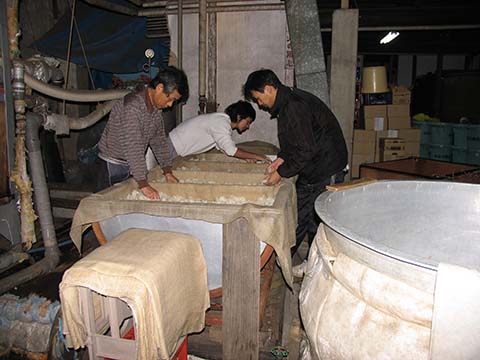
When the sake brewing starts in the fall the rhythm of each day is tied to the sake. During the night, I could hear the large rice steamer going as they cooked the rice. At about 5 a.m. they got up and scooped the rice onto a cooling table with a mesh bottom and an attachment that forces cold air through the rice. Using their hands they turned and mixed the rice to quickly cool it off, break it up and mix in the kōji. They use all their experience to determine when the rice is the proper temperature and consistency, and how much kōji to add.

img_0006_edited-2.jpg

The resulting malted rice was wrapped into cloth sacks and carried upstairs to a temperature-controlled warm room to rest for 2-3 days. During this time the mold develops and begins the process of breaking down the starches. When toji-san decides that the time is right, the malt rice is mixed with freshly steamed rice, water, and yeast and put into a stainless steel tank to ferment. The malt will convert the starch of the new rice into sugars and the yeast will convert the sugars into alcohol and flavors. This step also requires experience, knowledge and judgment to know if the tanks are too hot (and need to be packed in ice) and when the process is complete.

The Warm Room

The first bottling is a small run of the new unfiltered orisake – Chigoniwa produces about 1000 bottles each year. Many people wait every year just for this (similar to the anticipation of the Beaujolais Nouveau). Orisake still has the much of the rice sediments and live yeast. Mas says the taste of orisake makes you feel like it is now autumn.

After the orisake is bottled, the rest of the wine is filtered and bottled in various grades. This year their prime sake (the ginjō-shu) won the prize at a professional government-sponsored tasting contest.

img_0009_for_web_edited-1.jpg

< Previous | Home | Next >


Suiseki at the Asian Art Museum

November 18, 2007

The San Francisco Asian Art Museum is hosting a suiseki exhibit, put on by the California Suiseki Socity, as part of its AsiaAlive program (it will run through November 25, 2007). Mas and our friend Hideko Metaxas were asked to participate.

Hideko joined San Francisco Suiseki Kai when it was founded in 1981. She travels around the world lecturing on the display of the Japanese arts or bonsai, suiseki, and ikebana.

To accompany the suiseki exhibit Hideko created a formal display using, Mas’ Fuji-san suiseki, in the tokonoma of the museum’s tea room. The antique scroll and incense burner are from her collection.

< Previous | Home | Next >


Suiseki – Creative Daiza 2 (Nature)

August 25, 2007

“Nature”; W 10 1/2″ x D 5 3/4″ x H 6″;Serpentine from Clear Creek

A good suiseki combines human art and craft with nature to make a harmonious whole.

At the time Mas found this stone – in the mid-1990s – he didn’t know what to do with it. It has good color and shapeNature; Clear Creek Stone for suiseki, but the corners at the sides are missing and there is a sharp undercut on the back. Also, if you evaluate it based on san-men-no-hou (the rule of three dimensions), the proportions are wrong – it’s too high for it’s width.

In the traditional northern California form, the daiza rim makes a straight line across the stone. The emphasis is on showing the natural stone and the human-created element is minimized. For many stones I think this is a very beautiful way to display them (in particular stones that have a balanced harmony that makes for a quiet, elegant feeling). Nature with cut markHowever, very few stones have the kind of proportions and flat bottom that allow them to be finished without alteration. In most cases, you either have to cut the stone, or carve a daiza that is too deep for the stone’s proportions (unless it’s that rare stone with a fairly flat bottom and near-perfect shape). To finish “Nature” in this manner would require cutting the stone at the line shown – and Mas felt that it would lose its movement and excitement. Cutting a stone is always an option, but should only be done if it will improve the stone’s balance and harmony and result in a much better suiseki.

To solve the problem, Mas tried to carve a base that would complete the imperfect areas instead of hide them. In this way, the human element – the carved daiza – becomes an integral part of the composition. This requires the artist to find a balance between following nature and imposing a human vision. To be successful, it is necessary to observe nature – the stone and the wood – carefully and use artistic judgment to match the movement of the stone with the flow of the wood grain.

Driftwood and Daiza for “Nature”Shortly after completing this suiseki, he found this piece of driftwood at the Eel River. The similarity between the form of the driftwood and that of the daiza is sort of uncanny. Mas feels that by studying natural objects such as this driftwood you can get some valuable lessons for your life. He says he has learned from suiseki that “Nature is not perfect. I am way imperfect, so how can I expect other people to be perfect?”.

< Previous | Home | Next >


San Francisco Suiseki Kai – 26th Annual exhibit

August 3, 2007

This weekend (8/4-8/5) is the 26th exhibit for San Francisco Suiseki Kai. It is held in the hospitality room kindly provided by Union Bank in Japan Center. This year Mas and I will show three stones. Also, we are part of the “toban” group for the show this year, which means being responsible for tea and snacks for the members. Mas has been packing up all the stones, and making sure we have the right ji-ita for each one, while I’ve been getting these photos ready for posting. Then off to do our shopping and then to the city.

Meanwhile, we just got back from Lassen National Park. The stone there is volcanic, and pretty fresh at that – as such it is not suitable for suiseki (and anyway, it’s a National Park, which means look but don’t touch !). But anyone who loves stone and loves the mountains should visit Lassen. It is truly a national treasure.

After the weekend, I can catch up with regular life, and maybe even post the next article. It is a continuation of the creative daiza series, and explores some thoughts about how nature can inspire you in making daiza and presenting suiseki.

Click the picture to see the stones we are showing.

< Previous | Home | Next >


Suiseki – Creative Daiza 1 (Peace)

July 18, 2007
-Janet Roth

Jasper from Eel River; W 16" x D 7" x H 4" Mas found this stone in the early 1990’s on the Eel River. It was getting dark at the end of a long day of tanseki (stone collecting). He was getting ready to go home when he saw the little red peak sticking up above the sand. He tried to move it with his crowbar, with no particular expectation of anything.

Usually when you try to move a buried stone you find you can’t – the hidden part is too big or it’s stuck under other large rocks. Then, if you can dig it up, it turns out to have no shape or some other big problem. But this stone came out very easily, and when he picked up the stone to look at it he just said "ワオー" (Wow!). It was such an incredibly beautiful stone, he says he couldn’t believe it. The deep red jasper mountain range rising up behind the lake in the long valley gave him such a peaceful feeling. If you’ve been on tanseki, perhaps you know that feeling of joy and excitement; Mas likens it to finding some precious jewel.

Peace with first daizaHe made a daiza for this stone following the traditional style taught by California (and also Japanese) suiseki artists. A seat is carved into the wood to hold the base of the stone (this stone has not been cut, so the base is not flat), small uniform legs are made under the major visual masses, and the rim is flat all the way around. In this style, the daiza acts as a simple platform for the stone. The legs show just enough to visually support the weight of the stone, but otherwise are intended to almost disappear from the normal viewing angle (which is looking down slightly on the stone). The idea is to show the stone, the daiza itself is not considered important.

Daiza for Peace; W 16″ x D 7″ x H 3″At about this same time Mas was starting to develop his fine art sculpture (what he calls his "suiseki art"). As his eye and sensitivity to the stone developed, he became dissatisfied with this suiseki. He was also paying attention to the contemporary daiza being shown in the Japanese suiseki magazines. The flat daiza does not complement the movement and feeling of the stone, and the stone and base don’t integrate – simply put, it’s not beautiful. So, he carved a new daiza paying careful attention to the movement of the stone. The aim is to take two beautiful objects – a stone from nature and a daiza carved by the artist – and marry them to create the finished piece. The stone itself is just a stone. The daiza by itself is just wood carving. Together they make art, a suiseki.

The fine art sculpture and the traditional suiseki are never in conflict for him, but are aspects of the same thing. His art is grounded in the practice of suiseki, and he constantly comes back to making suiseki to refresh himself.

To me, this stone comes to life when cradled in the daiza – the curves in the rim bring out the movement and feeling of the stone. But note also the legs – they are larger than the traditional legs, and are not uniform. Each leg is made so as to echo and balance lines in the stone and thereby complement it. Instead of disappearing due to small size, the legs visually merge with, and help complete, the composition. Mas says that this suiseki was the first step towards achieving his dream of suiseki becoming fine art.

"Peace"; W 16" x D 7" x H 6"; Jasper and Genuine Mahogany

Back View

< Previous | Home | Next >


Suiseki Art 4 – Emotional Expression (9/11)

July 7, 2007
-by Mas Nakajima

I found this stone on the Klamath River, and left it in the yard for over 10 years in the wind, rain, and sun. I was expecting that this process, known as youseki, would clean up the stains and show the beautiful white snowy mountain. But after 10 long years there was little color change – in particular the gray did not change to white. The years of youseki instead gave it a wabi-sabi and aware feeling. Wabi-sabi in suiseki is an antique and rusty look, and aware is a feeling of pathos, sorrow, misery, and wretchedness all combined. (These are very important ideas in Japanese art and do not translate to English very well).

What could I do with such a sad feeling stone? I had no motivation to finish this stone as a suiseki, but I kept noticing and looking at the stone. Shortly after 9/11/2001 this stone caught my eye again – it reminded me of the collapsed twin towers.

I wanted to use 4×14 Douglas Fir, which is very commonly used as a structural beam in a building. I chose this piece since both the proportions and the grain seemed to complement the stone. I tried to position the stone very carefully, looking at the wood grain as well as the overall balance and composition. After setting the stone, I carved a deep hole and burned the wood with a blow torch. This is the first time in my suiseki art that I went beyond just staining and polishing the wood.
The stone has to me a feeling of total destruction, and I have tried to use it to express the deep sadness of that day.

"9/11"; W 27" x D 13" x H 9 1/2"; stone on carved, burned Douglas Fir

< Previous | Home | Next >


Suiseki Art 3 – Emotional Expression (Loneliness)

July 6, 2007
by Mas Nakajima

I was raised in a traditional wooden house in the countryside of Gifu, near the Japan Alps. Our house had three tokonoma (formal display alcoves) in various parts of the house. The tokonoma was a little space for sharing art with family and guests. This fit into the Japanese lifestyle of sitting on the tatami floor, perhaps enjoying the garden through the shoji or the paintings on the fusuma screens. My mother enjoyed her job of making the tokonoma displays, including selecting the seasonal flower arrangements, matching scrolls and other accompanying objects. This was part of the hospitality, along with serving the tea and cookies. Our family really enjoyed and appreciated her artistic displays.

I had been thinking to display this stone in a douban (antique copper suiban) as an isogata ishi or shore stone, perhaps accompaniedW 7″ x D 5″ x H 3/12″; stone for “Loneliness” by a scroll of birds flying. However, the house I built here in California did have a tokonoma, but in a western style living room, along with fireplace, couches and tables. There was no tatami floor and we sat on the couches instead. I tried suiban display and scroll in this contemporary tokonoma many times, and was never satisfied. Probably the atmosphere didn’t feel right and I couldn’t get the same joy and excitement that I used to share with my mother. In English there is the saying that “you can never go home again”, the reality never matches your memory.

At this time I had started feeling so lonely, living in the big house. My four children had all left home for college, and the distance was growing between my wife and me. I wanted to express my feelings through my art, but in a way that suited my American style of living.

Lonely guy sits with his memories in the darkness, struggling to move forward. The moon lights his way with a smile.

“Loneliness”, W 24″ x D 12″ x H 4 1/2″, stone and stain on poplar

< Previous | Home | Next >