Goshiki Numa

June 12, 2008

“Goshiki numa ” (五式沼 Five color pond) – 2007; W 5″ x D 4″ x H 3 1/2″; stone and black walnut

One day on the way home from a Klamath River stone-collecting trip we stopped near Eureka to poke around in a rock shop. Out in the yard they had a bin of these rocks for sale by the pound. They aren’t typical suiseki – being rather colorful and decorative – but they were so interesting and also inexpensive.  We spent quite a bit of time searching through the pile and selected a few to bring home. The bright colors in this one calmed down after a few months outdoors, so Mas made a simple base and we brought it inside to enjoy.

Last October we visited Yamagata, Japan. We had never thought to go there – it’s not a major tourist destination – but when we mentioned  to our friend Hideko Metaxas that we were going to Tōhoku (the northern part of the main island) she insisted that we visit her sister’s family in her home town of Yamagata.  As everyone knows, it is often exciting to get off of the major tourist route, and this trip turned out to be no exception. The visit to Yamagata was one of of the highlights of our Japan trip, and we are so grateful to Hideko-san and the Iwata family for making these arrangements.

The Iwata family’s hospitality is a memory we will cherish. During our two days they took us sightseeing all around the area. Spending the night at their house was like being at a first-class ryokan.  The sight-seeing tour included the Yamagata castle with its 400 year old cherry trees, the ancient Mountain Temple (Yamadera), the 350-year old Maple Garden and Tea House a short walk from their house, and the impressive Mount Zao, which is one of Japan’s most active volcanoes.

Okama, the crater lake near the top of Mt. Zao, is also known as the Five Color Pond (Goshiki numa 五色沼) because of the way it changes color from day to day.  When we returned home Mas noticed how our colorful little rock-shop stone evokes this image.  Whenever we look at this suiseki we remember our wonderful visit to Yamagata and our deep appreciation to the Iwata family.


Autumn in Yamagata
click to view gallery
2008 06 10 006-smart fix edited cropped
Suiseki display – Goshiki Numa
click to view gallery

< Previous | Home | Next >


The Cave

June 5, 2008

“The Cave” – 2008; W 18″ x D 10 ” x H 8 1/2″; Eel River stone and ash wood with stain

Mas collected this is stone from the Eel River.  The finished suiseki gives the image of a beautiful snow-covered distant peak with a deep, mysterious, cave underneath.

Mas spent a lot of time studying this stone to learn how to appreciate it as a suiseki, and in this article I want to share his  artistic process.  The main problem with the stone is the heavy left-hand side, which makes the stone very unbalanced.

Clicking on this picture will take you to a photo gallery that goes with this article.  I’ve put some detailed information in the captions for each photo.

The first set of pictures (1-7) show various possibilities for how to position the stone.  One solution is to cut the stone (picture 6).  This solves the imbalance by removing the left side, and would make a rather nice, simple toyama ishi (遠山石 or distant mountain stone).

As readers know, Mas sometimes will cut a stone when he feels it is artistically necessary, but in this case he did not want to. This meant that he had to find a way to handle the left side imbalance.  Mas said: “I know I am crazy and it doesn’t make sense, but I love this part as much as the beautiful snow mountain. The huge unbalance is so unique! Because of that reason, I would rather take a chance and try to create the art.

One option was to finish this as “suiseki art” similar to Looking Forward.  But the combination of the snow mountain overhanging the wide board didn’t seem to harmonize.

Alternatively, he could just simply make a daiza by filling up the space under the stone.  But this would result in a big wood wall in the front – sort of repeating the problem I discussed in The Struggle.

He wanted to change what seems like a negative into a positive. It is not unlike human life – we all have weaknesses of various kinds that aren’t going to go away.  We have to live with and work with these aspects of ourselves and others.

Once he has decided on his approach, he makes some sketches of the design, and then renders this design into a plaster model (Pictures 8 and 9).  Once he is satisfied with the design, Mas completes and refines the daiza in wood (Pictures 10 and 11).

The finished piece is shown from different angles in pictures 12-15. In this suiseki Mas tried to balance the weight of the stone with the emptiness of the cave.  He said “Dark, empty, space creates a mysterious feeling and allows people to use their own free imagination.

<Previous | Home | Next >


Carmel Trip

May 20, 2008

Golden State; Waves at sunset north of Santa Cruz; May 2008

Mas and I drove down to Carmel for a night to visit our friends Phil and Debby. On our first day, they took us to the Monterey Bay Aquarium. Debby used to be a docent there so she was our personal tour guide.

Many aquariums have a variety of fish tanks that show marine life from all over the world. The Monterey Bay Aquarium concentrates on the life local to the Bay. It is flushed daily with new water which brings with it the plankton from the bay. The exhibits are filled with small animals, such as anemones, that have seeded themselves from the outside.

The displays and tanks are all carefully constructed by someone with a restrained, artistic eye. The jellyfish exhibit stands out in my memory – it is hauntingly beautiful.

The next day we visited a couple of art galleries in Carmel, including the Winfield Gallery. The owner, Chris Winfield, is the older brother of Robin Winfield – one of the gallery artists and my high-school classmate. It was nice to see Robin and Chris, and the gallery was a treat. He represents a large group of artists, including their father, Rodney Winfield, and all three of Chris’ siblings (Robin, David, and Nancy). It also turned out that Debby and Chris had gone to the same high school in St. Louis and knew people in common!

After a lovely outdoor lunch at the Village Corner restaurant, we enjoyed the 17-mile drive along the beautiful Monterey Bay shore. A highlight of our tour was the view of the Walker Residence, designed in the 1940’s by Frank Lloyd Wright. Mrs. Walker asked him to design a small house (she lived alone) that would fit into the landscape and not block anyone else’s views. The house seems like an extension of the land it sits on. After all the grandiose mansions of Pebble Beach, this little house is beautiful in its modesty.

After saying goodbye to our friends, we drove home on Highway 1 along the Pacific Ocean, and stopped to watch the sun go down. We sat on the cliff, all alone in the quiet, and enjoyed the brilliant, golden sunset.

(click here for more pictures)

< Previous | Home | Next >


The Struggle

May 2, 2008

Forest - 2007; W 17 1/2

Forest – 2007; W 17 1/2″ x D 8 1/2″ x H 9″; Klamath river stone and poplar

Mas made this suiseki last autumn. At the time he had such a feeling of accomplishment, finishing such a difficult daiza. He brought it into the dining room and we enjoyed looking at it every day. But after a few days the excitement kind of disappeared. It just couldn’t stand up next to the fine traditional suiseki in the room.

Mas been struggling with this stone for a long time. It’s a beautiful piece of material from the Klamath River, but the feeling from the stone doesn’t transfer to the finished suiseki. The peak is small and indistinct relative to the vertical and horizontal expanse and there are many features spread out over the surface. It feels like a big wall, too busy and with no focal point.

A suiseki friend was visiting a while ago, and he suggested that Mas cut the stone and make a simple base. Of course this he had considered this possibility. It would solve the vertical wall problem, and would also help give the stone better proportions – a distinct peak and good kamae (good seat or posture). But cutting is a last resort, and Mas always wants to explore all the other possibilities. He feels that it is an incredible stone, even though it does not follow the traditional suiseki style. So what to do? He really wants to “take care” of the stone – and show the deep meaning of stone appreciation.

The other night Mas showed me a picture of his first attempt to finish this stone from several years ago.

Wave (after Hokusai) - 2000; W 24

Wave – 2000; W 24″ x D 12″ x H 11″; Stone, Douglas Fir with paint

This was one of his very early experiments with using a board for his “suiseki art”. The stone evokes the image of a great wave, and that reminded him of this print by Hokusai, so he carved and painted Great Wave off Kanagawathe board in a deliberate reference to the print. The result was not satisfying to him. The board is too busy, competing with the stone, and the carving does not harmonize with the form of the stone.

Nevertheless, I was kind of excited by the picture. The stone, presented in this way, seems really powerful to me. It gives me the image of a strong and ancient rock slowly being eroded away by the power of the sea. Mas now feels encouraged to try again, and I look forward to someday being able to finish this story.  He says that if he simply concentrates how to create a “Wave”, without any preconceived concepts, then all the rest will follow.

As Hemingway once put it:

“No good book has ever been written that has in it symbols arrived at beforehand and stuck in,” says Hemingway. “That kind of symbol sticks out like raisins in raisin bread. Raisin bread is all right, but plain bread is better.” He opens two bottles of beer and continues: “I tried to make a real old man, a real boy, a real sea and a real fish and real sharks. But if I made them good and true enough they would mean many things. The hardest thing is to make something really true and sometimes truer than true.”

< Previous | Home | Next >


Evocation

April 15, 2008

“Crater Lake”; W 5″ x D 4 1/4″ x H 3″; Eel River Stone with walnut base

Many years ago my mother and I took a road trip around Northern California and Oregon. We started out going north on Highway 101 from San Francisco, in order to visit the redwood forests of California’s North Coast. These are wet, mysterious places where trees soar to incredible heights; their carcasses lie on the forest floor rotting slowly in the moist air. In both life and death the trees offer sustenance to all the life around them.

After joining the Pacific coast, the highway hugs the shoreline through Oregon and beyond to the Olympic Peninsula of Washington State. The coast of Oregon is a wild and beautiful place, with great rocks battered by the sea. We stopped in Gold’s Beach to enjoy a short raft trip on the Rogue River, which pours down out of the Klamath mountains, and then continued up the coast of Oregon until we decided to turn inland. We wanted to go see Crater Lake.

In the short 100 miles from the coast to Crater lake you pass through many different environments. Leaving the seashore behind, you go over lush coastal mountains full of Douglas Fir and Port Orford Cedar, interspersed with picturesque dairy farms. From there you drive through the rich, fertile farmland of the Willamette Valley and start the climb into the high country of the Cascade mountains.

Crater Lake was formed in the caldera left behind after an ancient volcano, Mt. Mazama, collapsed more than 7500 years ago. The rim is at an elevation of about 7000 ft, and is 1000 feet above the surface of the lake. (At its deepest point, the lake itself is nearly 2000 feet deep.) Since the collapse of Mt. Mazama, small eruptions inside the caldera have formed some cinder cone islands. Crater Lake is an amazing, mystical place and it is no wonder that it continues to be a sacred site for the local Native American Klamath Tribe.

Crater Lake; Photo by Mas Nakajima; July 2, 2005

Not too long after this trip I went with some friends for tanseki to the Eel River. I remember climbing down the long steep rock wall to the river below. Just as we were about to leave I found this tamari (water pool stone) lying face up on the ground, seemingly waiting for me to find it.

It’s a very hard stone, made of a deep beautiful black mineral – perhaps jasper. It looks a bit like an egg that has broken open. The wide snow-dusted rim around the deep lake, with the island near the shore, makes it the image of Crater Lake.

When Mas first visited my house he immediately spotted this stone outside on the bonsai bench. He says that for him the stone shows the beauty of simplicity and purity, which is the essence of suiseki. He made the daiza as one of his first gifts to me. Mas says that for Japanese people a tamari does not just represent a water pool, but also brings good fortune for your life.

Whenever I look at this stone I remember the day on the river with my friends, I think about the trip I shared with my mother, and I feel the richness of my life.

< Previous | Home | Next >


Time Will Tell

April 5, 2008

“Winter Blue”; 2008; 48″ x 24″; Oil paint on wood board

The next show at the Triangle Gallery, Time Will Tell, will run April 15-May 31 and includes selected artwork from Gallery Artists. Mas will exhibit two paintings and one suiseki art sculpture. (You can click on the photo to see a slideshow of all three pieces).

These past few months have been kind of exciting for me. Mas has been making some real advances in his technique and style with spray paint on wood, and it seems like almost every day there’s a new painting to study and critique. Winter Blue is one of my favorites. I look at it every morning while I drink my tea.

< Previous | Home | Next >


The Reveal

March 31, 2008

Mas and I found this stone on our first date, a collecting trip to Black Butte Reservoir in Northern California. It was Thanksgiving weekend in 2004 and the weather was ice cold and with a strong north wind blowing. The stone has several significant features, including the amazing autumn colors, the large tamari or waterpool, and the steep cliff recessed under a big overhang. By contrast, the surface features, including the two small peaks to either side of the tamari, are more restrained and gentle.

Soon after bringing it home, Mas made a daiza. Sometimes when so many interesting features are present the viewer’s eye gets lost. Simplicity is one of the most important aesthetic virtues for a suiseki. Mas wanted to simplify the stone by emphasizing the tamari and surface features. This gives the suiseki a modest, settled feeling. We kept the suiseki in the living room and enjoyed our memories of that day.

Recently, Mas took the stone out of the daiza and put it on the table. He didn’t have any intention of redoing it, but while looking at the stone he started appreciating the cliff area. He thought it enhanced the stone rather than detracting so he decided to open up the front of the daiza to reveal this unique feature.

It seems to me that he has revealed the heart of the stone. Its features combine in a dynamic harmony, and the recessed cliff gives a sense of depth and mystery. Removing the wall of wood from the front also allows the eye to appreciate the subtle movements of the stone surface, and perhaps creates more room for the viewer’s imagination.

Untitled; W 10″ x H 4″ x D 7 1/2″; Jasper and Black Walnut

< Previous | Home | Next >


To Cut or Not to Cut

March 9, 2008

The central feature of a suiseki art piece is a found object – a stone – that has been shaped entirely by Nature. So it’s understandable that, whenever suiseki lovers get together, the conversation almost always gets around to the issue of whether or not it is okay to cut a stone when making a suiseki.

There are different teachings and practices both here in the U.S. and in Japan (and much argument in both places). In my view it’s really an artistic decision rather than a matter of “okay” or “not okay”.

Some people come at the cutting issue from a conceptual point of view – they often express the feeling that cutting a stone damages the spirit of the stone. (Many people use the Japanese term kami, but the ancient Greek concept of a nymph probably serves just as well.) This is certainly in keeping with the historical roots of suiseki as objects which brought Nature indoors for Zen meditation and the Tea Ceremony. Suiban display is commonly used to express this feeling.

Other people are more concerned with the suiseki as a visual object. In this view, the artistic composition – the line, form, and visual balance – is the primary concern. For this group, it is acceptable to cut a stone if it improves the artistic composition – provided that it results in a good suiseki. Suiseki is treated more as Art in our modern sense, rather than seeing it through the lens of traditional spiritual belief. (See my earlier post on that topic.)

Neither point of view is “right” or “wrong”, and they aren’t even mutually exclusive. Some people emphasize the conceptual – and may be more forgiving of compositional “flaws” in uncut stones. The other group emphasizes the composition and is more forgiving of the human intrusion of cutting.

Here in Northern California, most people seem to follow the same practice as the Nippon Suiseki Association (see their FAQ here). We consider stone cutting to be acceptable – though good un-cut stones are more valued. There is however one significant difference between our practice and the Japanese practice.

For aesthetic reasons, the Japanese artists use various techniques (such as sandblasting) to modify the bottom face and edges of a cut stone so as to conceal the smooth face. In some cases additional work may even be done on the visible parts of the stone to modify the shape. This work is usually done very skillfully and is difficult to detect. (In the commercial world of course the seller should disclose this to you. I have a couple of Japanese suiseki, and I only found out later that they had been modified. However, they are beautiful stones and I enjoy them both.)

By contrast, our Northern California practice is to grind the sharp edges in order to make a good transition into the daiza, and no attempt is made to conceal the cut face itself. I am not aware of any Northern California artists (or commercial dealers) that make a practice of modifying the visible shape and people consider it to be improper and not part of the suiseki aesthetic.

Mas feels that the decision depends on the individual stone and what it needs. He will cut a stone, but only when the resulting suiseki will be very good.

Late Fall (shown in the photo below) is an fine example of a cut-stone suiseki. It is a classic mountain-shaped stone (山形 yamagata) that meets all the requirements of the rule of three-sides (三面の法 sanmen-no-hou). It has good asymmetrical balance, a well-defined straight peak, and the peak and both ends all come slightly forward towards the viewer (what is called good kamae 構). The stone material is good well-weathered serpentine, with a subdued deep brown color and interesting textures that enhance the lines of the stone, and is starting to show age and patina. This suiseki is currently in our entry way, and I enjoy seeing it every time I walk through.

“Late Fall”; W 16″ x D 7″ x H 6″; Clear Creek serpentine

< Previous | Home | Next >


Something old, something new

January 23, 2008

We held the Bay Island Bonsai 9th annual exhibit this past weekend, and for the third year in a row Mas was a guest exhibitor. Boon gives him free rein to do whatever he wants, so last year he made an entirely contemporary display with his Suiseki Art piece “Akebono”. This year Mas chose to combine a very traditional suiban display with one of his recent paintings. After creating the display, he titled it “Silence” (静寂 seijaku).

When we were creating this display Mas first tried a more traditional approach, using a calligraphy scroll that his mother had given us. The scroll has the character 然 (zen) which comes from the word shizen, or “nature”. It didn’t look good – the calligraphy was very strong and overpowered the stone, stealing all the attention. On top of that, the meaning of calligraphy is an essential part of it – you aren’t using it just for its visual appearance. Something essential is lost if the great majority of viewers don’t know the meaning.

So we started looking at some of Mas’ recent paintings from last summer. This painting was not made with any intention of displaying it with a suiseki, but when we tried it with this stone and suiban we realized how well they complemented each other.

Mas deliberately avoided giving a descriptive name or label to either the stone or painting . Having a description such as “coastal rock” or “waterpool” limits the viewer’s own imagination. For me, this display is a memory of morning on the Klamath river, surrounded by forest, with the mist rising off the water. For a fellow BIB member (of more practical bent perhaps) the painting seemed like a micrograph of the stone itself.

Having a suiseki display among bonsai gives a moment’s rest while going though the exhibit. In the midst of the trees is a quiet clearing where you can gather your thoughts and go on refreshed.

< Previous | Home | Next >


The Art of Craft

December 27, 2007


Mas and I recently visited his family home in Dachi, a small town in Gifu prefecture. Mas’ older brother, Zenji Nakashima, runs the family business, a small sake brewery named Chigonoiwa. The new rice from the harvest was available and they were just beginning the year’s sake making.

20071018-IMG_0018 3264 x 2448

The basic idea for making sake is simple. You take highly polished rice and cook it; mix in enzymes (in the form of a mold called kōji) that break the starch down to sugar, add water, yeast, and time and you end up with sake. But of course, this simplicity masks the complexity which is the sake brewer’s art.

When Mas was a child the toji (brew master) would come every fall from Niigata with a team of workers to make the sake. They were farmers who had no work at home once the snows came. They left their wives and families behind, and lived all winter at the brewery with the Nakashima family. Now of course this system is pretty much gone. The farmers have other means of year-round employment nearer to their homes and no longer need to spend months apart from their families.

The economics of the sake business have also changed since those post-war days. A few large breweries dominate the business, using efficient mass-production techniques to make good, inexpensive sake and distribute it around Japan (and indeed the world). The only way for a family brewery to compete is to stay small and make very high-quality sake.

So now the oldest son, Daizo, is toji-san. He, his father, and his brother Sunao make the sake. Chigonoiwa is distributed strictly locally, but through the internet it also reaches connoisseurs around the country (Daizo is also the company webmaster).

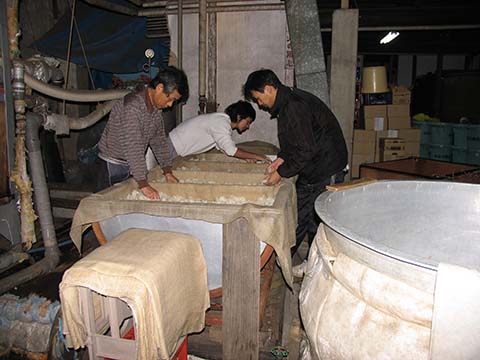
When the sake brewing starts in the fall the rhythm of each day is tied to the sake. During the night, I could hear the large rice steamer going as they cooked the rice. At about 5 a.m. they got up and scooped the rice onto a cooling table with a mesh bottom and an attachment that forces cold air through the rice. Using their hands they turned and mixed the rice to quickly cool it off, break it up and mix in the kōji. They use all their experience to determine when the rice is the proper temperature and consistency, and how much kōji to add.

img_0006_edited-2.jpg

The resulting malted rice was wrapped into cloth sacks and carried upstairs to a temperature-controlled warm room to rest for 2-3 days. During this time the mold develops and begins the process of breaking down the starches. When toji-san decides that the time is right, the malt rice is mixed with freshly steamed rice, water, and yeast and put into a stainless steel tank to ferment. The malt will convert the starch of the new rice into sugars and the yeast will convert the sugars into alcohol and flavors. This step also requires experience, knowledge and judgment to know if the tanks are too hot (and need to be packed in ice) and when the process is complete.

The Warm Room

The first bottling is a small run of the new unfiltered orisake – Chigoniwa produces about 1000 bottles each year. Many people wait every year just for this (similar to the anticipation of the Beaujolais Nouveau). Orisake still has the much of the rice sediments and live yeast. Mas says the taste of orisake makes you feel like it is now autumn.

After the orisake is bottled, the rest of the wine is filtered and bottled in various grades. This year their prime sake (the ginjō-shu) won the prize at a professional government-sponsored tasting contest.

img_0009_for_web_edited-1.jpg

< Previous | Home | Next >