Suiseki Stories

July 7, 2025

Suiseki Stories — What if a single stone could hold a mountain, a memory, or a glimpse of the universe itself?

Suiseki Stories is a unique and deeply personal collection of reflections from artists, collectors, and contemplatives from all over the world who have been shaped by the quiet beauty of suiseki—the Japanese art of viewing stones that evoke natural scenes or forms.

It is an art form both humble and profound—one in which a stone can suggest not only a landscape or a living being, but also evoke a world beyond the visible, inviting moments of deep stillness, imagination, and connection.

In this book, we do not aim to define suiseki for the world—nor could we. We recognize that suiseki, born of Japanese aesthetics, holds meanings and subtleties that are not universally agreed upon or easily understood outside its native context. Instead, Suiseki Stories offers something simpler and perhaps more powerful: a chorus of individual voices, each sharing their own experience of stones that moved them, changed them, or called them to reflect more deeply on life.

With 195 pages of striking photographs and intimate stories from across the globe, Suiseki Stories reveals how this ancient practice lives today—not as a fixed tradition, but as a personal and evolving journey.

Ideal for:

  • Suiseki, stone appreciation, and bonsai enthusiasts
  • Lovers of Japanese aesthetics, wabi-sabi, and contemplative arts
  • Readers drawn to the intersection of nature, memory, and meaning
  • Anyone who has ever found wonder in an ordinary stone

Let these stories inspire your own!

To purchase the printed book, click here .

To purchase the digital edition of the book contact Sam Edge at: suisekistories@gmail.com

The digital PDF version of the book is US $24.95. The printed book is available for US $59.99 for hardbound and $49.99 for softbound (or the equivalent in other currencies).


Goshiki Numa

June 12, 2008

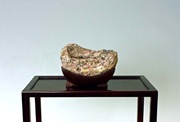
“Goshiki numa ” (五式沼 Five color pond) – 2007; W 5″ x D 4″ x H 3 1/2″; stone and black walnut

One day on the way home from a Klamath River stone-collecting trip we stopped near Eureka to poke around in a rock shop. Out in the yard they had a bin of these rocks for sale by the pound. They aren’t typical suiseki – being rather colorful and decorative – but they were so interesting and also inexpensive.  We spent quite a bit of time searching through the pile and selected a few to bring home. The bright colors in this one calmed down after a few months outdoors, so Mas made a simple base and we brought it inside to enjoy.

Last October we visited Yamagata, Japan. We had never thought to go there – it’s not a major tourist destination – but when we mentioned  to our friend Hideko Metaxas that we were going to Tōhoku (the northern part of the main island) she insisted that we visit her sister’s family in her home town of Yamagata.  As everyone knows, it is often exciting to get off of the major tourist route, and this trip turned out to be no exception. The visit to Yamagata was one of of the highlights of our Japan trip, and we are so grateful to Hideko-san and the Iwata family for making these arrangements.

The Iwata family’s hospitality is a memory we will cherish. During our two days they took us sightseeing all around the area. Spending the night at their house was like being at a first-class ryokan.  The sight-seeing tour included the Yamagata castle with its 400 year old cherry trees, the ancient Mountain Temple (Yamadera), the 350-year old Maple Garden and Tea House a short walk from their house, and the impressive Mount Zao, which is one of Japan’s most active volcanoes.

Okama, the crater lake near the top of Mt. Zao, is also known as the Five Color Pond (Goshiki numa 五色沼) because of the way it changes color from day to day.  When we returned home Mas noticed how our colorful little rock-shop stone evokes this image.  Whenever we look at this suiseki we remember our wonderful visit to Yamagata and our deep appreciation to the Iwata family.


Autumn in Yamagata
click to view gallery
2008 06 10 006-smart fix edited cropped
Suiseki display – Goshiki Numa
click to view gallery

< Previous | Home | Next >


The Art of Craft

December 27, 2007


Mas and I recently visited his family home in Dachi, a small town in Gifu prefecture. Mas’ older brother, Zenji Nakashima, runs the family business, a small sake brewery named Chigonoiwa. The new rice from the harvest was available and they were just beginning the year’s sake making.

20071018-IMG_0018 3264 x 2448

The basic idea for making sake is simple. You take highly polished rice and cook it; mix in enzymes (in the form of a mold called kōji) that break the starch down to sugar, add water, yeast, and time and you end up with sake. But of course, this simplicity masks the complexity which is the sake brewer’s art.

When Mas was a child the toji (brew master) would come every fall from Niigata with a team of workers to make the sake. They were farmers who had no work at home once the snows came. They left their wives and families behind, and lived all winter at the brewery with the Nakashima family. Now of course this system is pretty much gone. The farmers have other means of year-round employment nearer to their homes and no longer need to spend months apart from their families.

The economics of the sake business have also changed since those post-war days. A few large breweries dominate the business, using efficient mass-production techniques to make good, inexpensive sake and distribute it around Japan (and indeed the world). The only way for a family brewery to compete is to stay small and make very high-quality sake.

So now the oldest son, Daizo, is toji-san. He, his father, and his brother Sunao make the sake. Chigonoiwa is distributed strictly locally, but through the internet it also reaches connoisseurs around the country (Daizo is also the company webmaster).

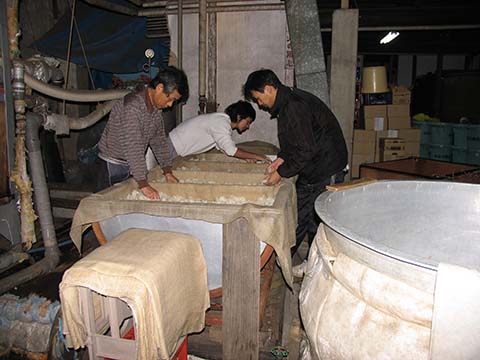
When the sake brewing starts in the fall the rhythm of each day is tied to the sake. During the night, I could hear the large rice steamer going as they cooked the rice. At about 5 a.m. they got up and scooped the rice onto a cooling table with a mesh bottom and an attachment that forces cold air through the rice. Using their hands they turned and mixed the rice to quickly cool it off, break it up and mix in the kōji. They use all their experience to determine when the rice is the proper temperature and consistency, and how much kōji to add.

img_0006_edited-2.jpg

The resulting malted rice was wrapped into cloth sacks and carried upstairs to a temperature-controlled warm room to rest for 2-3 days. During this time the mold develops and begins the process of breaking down the starches. When toji-san decides that the time is right, the malt rice is mixed with freshly steamed rice, water, and yeast and put into a stainless steel tank to ferment. The malt will convert the starch of the new rice into sugars and the yeast will convert the sugars into alcohol and flavors. This step also requires experience, knowledge and judgment to know if the tanks are too hot (and need to be packed in ice) and when the process is complete.

The Warm Room

The first bottling is a small run of the new unfiltered orisake – Chigoniwa produces about 1000 bottles each year. Many people wait every year just for this (similar to the anticipation of the Beaujolais Nouveau). Orisake still has the much of the rice sediments and live yeast. Mas says the taste of orisake makes you feel like it is now autumn.

After the orisake is bottled, the rest of the wine is filtered and bottled in various grades. This year their prime sake (the ginjō-shu) won the prize at a professional government-sponsored tasting contest.

img_0009_for_web_edited-1.jpg

< Previous | Home | Next >